

Team charter
How to create a team charter
A team charter is a short agreement about why the team exists and how it will work together. Done well, it turns your organisation's values from words on a poster into behaviour people recognise. Done badly, it becomes one more document nobody reads.
The short answer: a team charter sets out the team's purpose, what the organisation's values look like in this team's day-to-day work, who is responsible for what, and how the team will make decisions and handle disagreement. Create it with the team over two or three short sessions, keep it to a page, and refer to it every week.
Why bother with a charter?
Most friction in teams isn't about personalities. It's about unspoken assumptions: who decides, what "urgent" means, how quickly people should reply, what happens when someone disagrees. A charter brings those assumptions into the open while things are calm, so they don't explode when the pressure is on.
What to include in a team charter
- Our purpose. One or two sentences on why the team exists and how it contributes to the organisation's goals. See creating a team vision.
- Our values in action. For each of the company's values, two or three concrete examples of what it looks like in this team.
- Roles and responsibilities. Who owns what, and who makes which decisions.
- How we work. Meetings, response times, how work is shared out, focus time.
- How we disagree. How the team raises concerns, debates and then commits.
- How we'll keep it alive. When and how the team will check in on the charter.
Start with the values you already have
In most large organisations the values are already set and you can't change them. That's fine. They are the parameters the team works within. What you can do is define what they mean for your team, and how you will bring them to life.
Early in my career, at a global financial services firm, we were given ten values in a half-day session. The language was so heavy and impenetrable that it meant nothing to us. We were in our mid-20s, supposedly the next generation of leaders, and we left totally cynical about values. That's what happens when values stay as words.
How to create a team charter in three short sessions
-
Session one: what's been your experience?
Start by asking people about their past experience of team values and ways of working, good and bad. Some will be cynical. You need to know what you're dealing with before you can change it. Then agree the team's purpose and walk through the company values together.
-
Session two: make the values specific
A value like "courage" means something different to every person who hears it. For each value, ask: "What do we do when we show this value at its very best?" and push for concrete examples. "When we show courage at its best, we take on the tough problems instead of putting them off" is something people can act on. Agree roles and ways of working in the same session.
-
Session three: agree how you'll live it
This is the session most teams skip, and it's the one that matters most. How will the charter show up in everyday conversation? Ideas that work: a weekly call-out of two people who lived one of the values, with the specific example; a quick check against the charter at the end of each month; something visual the team creates for the wall or the team channel.
Wrap up each session by summarising what you've agreed and thanking people. It sounds small, and it makes the next session easier.
Free team charter template
Copy this team charter template into a document or your team channel and fill it in together. Keep the finished version to a single page.
[Team name] team charter
1. Our purpose
We exist to [what the team does] so that [who benefits and how]. This helps [organisation] to [the company goal we contribute to].
2. Our values in action
For each company value: "When we show [value] at its very best, we..."
- [Value 1]: we [specific behaviour] and we [specific behaviour].
- [Value 2]: we [specific behaviour] and we [specific behaviour].
- [Value 3]: we [specific behaviour] and we [specific behaviour].
3. Roles and decisions
- [Name] owns [area] and decides [type of decision].
- Decisions about [topic] are made by [person or group], after hearing from [who].
- In an urgent situation, [name] makes the call.
4. How we work
- Meetings: [which meetings, how often, how long].
- Response times: [what "urgent" means and how fast we reply].
- Focus time: [when we protect time with no meetings].
- Sharing work: [how we spread the interesting and the dull work fairly].
5. How we disagree
We raise concerns [where and how]. We debate openly, then commit to the decision, even if we argued against it. Problems are raised early, not saved up.
6. How we keep this alive
- Every week: [the ritual, for example two people recognised for living a value, with the example].
- Every month: [a ten-minute check on what's working and what isn't].
- Every [quarter]: we review and update this charter.
The mistake to avoid
Don't write it yourself. I once came back from a conference full of energy, wrote six values for my own team within a day, arranged so their first letters spelled a neat word, and presented them the next day. The team just shook their heads. They weren't our values. They were mine. If you aren't prepared to do it properly, with the team, it's better not to do it at all. Values done badly can look like a management technique and undermine trust.
Try this week: take one company value to your next team meeting and spend 15 minutes on "What do we do when we show this at its very best?" Write down the answers. That's the first line of your charter.
Questions people ask
What is a team charter?
A short written agreement, created by the team, about its purpose, what its values look like in practice, who is responsible for what and how it will work together and handle disagreement.
Is there a team charter template I can use?
Yes. This page includes a free team charter template covering purpose, values in action, roles and decisions, ways of working, how the team disagrees and how it keeps the charter alive. Copy it and fill it in with your team.
What should be in a team charter?
Purpose, values turned into specific behaviours, roles and decision rights, working norms such as meetings and response times, how the team handles disagreement, and how it will keep the charter alive.
Can you create a team charter if company values already exist?
Yes, and that's the usual situation in a large organisation. The charter doesn't replace the company values. It defines what they mean for your team and how you'll live them day to day.
Related guides
Sources
The stories and practical ideas on this page come from the book. The figures in the blue boxes come from the published research below.
- Harter, J. (2026). U.S. Employee Engagement Declines From 2020 Peak. Gallup.
- Dvorak, N. and Nelson, B. (2016). Few Workers Apply Their Company's Values to Their Jobs. Gallup Business Journal.
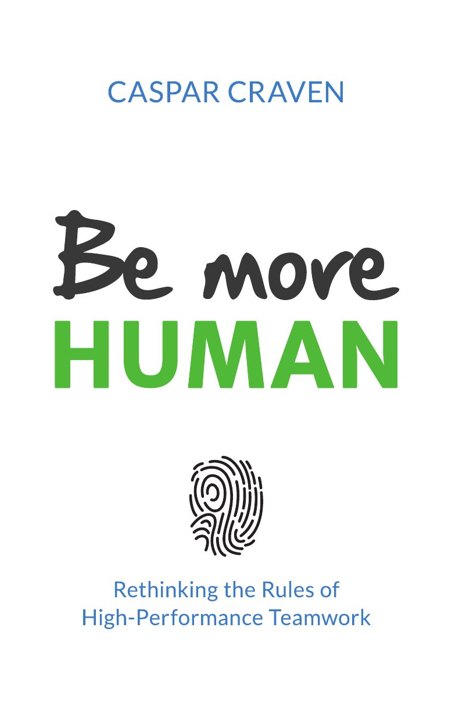
From the book Be More Human
The ideas and stories on this page come from Be More Human: Rethinking the Rules of High-Performance Teamwork by Caspar Craven: what he learnt, often the hard way, about building teams in business, at home and at sea. It's written for anyone asking why their team isn't getting the results it could, or what's wrong with the culture.