
Teamwork
High-performing teams: what the best teams do differently
Most of what we're taught about high-performing teams comes from elite sport. It's only half the story. The teams that perform best over the long run look less like a squad chasing a trophy and more like a group of people who trust each other completely.
The short answer: high-performing teams are built on trust, a shared story of where they are going, clear roles, people working to their strengths and a willingness to own problems rather than blame. They pay attention to how people feel, not just what they deliver. Research on team intelligence found that how well members read each other and share airtime matters more than how clever individuals are.1
The problem with the sports model
Conference stages are full of Olympians and championship winners, and their stories of drive and marginal gains are genuinely inspiring. But sport is built around a finish line. There is a gold medal, a final whistle, a season that ends. Business borrows the same thinking with monthly, quarterly and annual targets, and the result is a cycle of highs and lows: a push to hit the number, a brief celebration, then the next number.
In 2000 I sailed around the world as a watch leader on one of twelve identical yachts in an ocean race. Our skipper's motto was "a fast team is a happy team". If the boat went fast, everyone would be happy. In practice the focus on speed came at the expense of the people on board. The crew wasn't fully engaged or working in harmony, and during a race around a harbour in New Zealand we crashed at speed into another yacht. The skipper was replaced shortly after.
She had it the wrong way round. A happy team is a fast team.
Seven things high-performing teams have in common
Whether you call them high-performing teams or high-performance teams, the best ones I have seen and studied share the same seven characteristics.
-
Deep trust
In that ocean race we sailed through storms and huge seas in the Southern Ocean, changing sails on the bow of the boat with waves sweeping across the deck. Over ten months, the trust between crew members became absolute, because one wrong move could cost a life. Most teams don't face stakes like that, but the principle holds. If there is a seed of doubt about whether people can rely on each other, it shows up the moment pressure arrives.
-
Everyone gets heard
In weaker teams, a couple of voices dominate. In strong ones, people take turns and pay close attention to how others are feeling.
-
A shared story
The best teams know where they are going and why it matters, in words simple enough to repeat. Not a long mission statement, but a story people helped to write and feel proud of. See how to create a team vision.
-
Clear roles, especially under pressure
When my wife and I later sailed around the world with our three young children, we learnt this one the hard way. On land we were husband and wife, deciding things together. At sea in a storm, one person had to make the call quickly. The first time I spoke sharply during a difficult sail change, it didn't go down well. In the debrief afterwards we agreed when each role applied. Every team needs that clarity: who decides what, and when.
-
People playing to their strengths
Think of a team as an orchestra rather than a row of identical players: you arrange people so their strengths complement each other and cover each other's weaknesses. Spending time shoring up weaknesses produces mediocre results at best.
-
Ownership instead of blame
When something goes wrong, people in strong teams ask "what could I have done differently?" before "whose fault was it?". It starts with the leader going first. More in accountability in the workplace.
-
A long-term view
Thriving teams still set ambitious goals, but they treat the goal as a way of building the skills and the team, not as the only thing that counts. That's what keeps performance high after the target has been hit.
From high-performing to thriving
I'd go one step further than "high-performing". The word "perform" suggests playing a part, acting rather than being yourself. The teams worth building are thriving high-performance teams: they deliver outstanding results on a sustainable basis, and the people in them are doing well in their lives, not just at work. A family is a better model for that than a sports team. In a family there is no finish line. It's a long-term relationship that gets stronger over time, and everyone's contribution counts.
How to start
If you lead a team inside a large organisation, you don't need permission for any of this. Start with trust: sit down with each person, listen properly and act on what you hear. Then work with the team on a shared story and clear roles. The rest builds on those foundations.
Try this week: in your next team meeting, watch who talks and who doesn't. Next time, deliberately invite the quieter voices in first.
Questions people ask
What are the characteristics of a high-performing team?
Deep trust, everyone being heard, a shared story of where the team is going, clear roles, people working to their strengths, ownership rather than blame, and a long-term view of success.
How do you build a high-performing team?
Start with trust by listening properly to each person and acting on what you hear. Then agree a shared direction and clear roles together, and build ways of working that use each person's strengths.
Can a team in a large organisation become high-performing?
Yes. Most of what makes a team perform well, such as trust, clarity, strengths and ownership, sits within the team itself and the person leading it.
Related guides
Sources
The stories and practical ideas on this page come from the book. The figures in the blue boxes come from the published research below.
- Woolley, A., Chabris, C., Pentland, A., Hashmi, N. and Malone, T. (2010). Evidence for a Collective Intelligence Factor in the Performance of Human Groups. Science, 330(6004), 686 to 688.
- Edmondson, A. (1999). Psychological Safety and Learning Behavior in Work Teams. Administrative Science Quarterly, 44(2), 350 to 383.
- Gallup (2014). Employees Who Use Their Strengths Outperform Those Who Don't.
- Gallup (2024). The Relationship Between Engagement at Work and Organizational Outcomes: Q12 Meta-Analysis, 11th edition.
From the book Be More Human
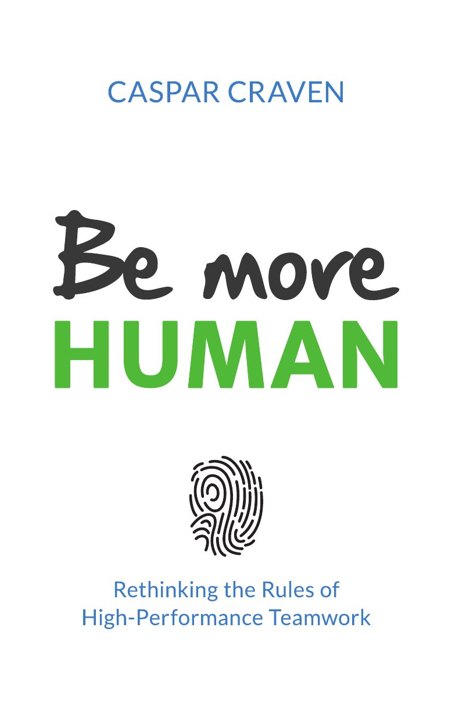
The ideas and stories on this page come from Be More Human: Rethinking the Rules of High-Performance Teamwork by Caspar Craven: what he learnt, often the hard way, about building teams in business, at home and at sea. It's written for anyone asking why their team isn't getting the results it could, or what's wrong with the culture.