

Team culture
How to build a team culture people want to belong to
Every team has a culture, whether anyone designed it or not. It is simply the way people behave when nobody is checking. The good news is that a team leader has more influence over it than they might think, even inside a big organisation.
The short answer: team culture is what people actually do every day: how they speak to each other, how they handle mistakes and whether they feel safe to speak up. You build a good one through consistent behaviour, starting with the leader: listening properly, turning values into specific actions, recognising what's going well and owning problems rather than blaming. It's slow work, and it compounds.
Culture is what people do, not what's on the wall
When Lou Gerstner took over IBM in 1993, the company was losing billions. He later wrote that he hadn't expected to spend time on culture. He thought of it as one tool among many. By the end he concluded that culture wasn't just one aspect of the game, it was the game. He also observed that too many values are just words that never translate into practices.
That's the heart of it. Your organisation may have an excellent set of values and a polished culture statement. Your team's culture is what happens in the meeting on Wednesday afternoon.
The signs of a culture of fear
A team can be friendly on the surface and still be running on fear. Some signs to watch for:
- People pay lip service to requests but don't really follow through.
- Nobody owns mistakes. The finger of blame points to someone else or to circumstances.
- People keep their ideas and their work to themselves, for fear of criticism or of being found out.
- New ideas get the eye-roll: "Oh, another one of those."
- You have a quiet feeling that if a better offer came along, people would go.
I recognise every one of those, because I created them. Under pressure in my early days running a business, I was erratic and made unreasonable demands. Trust eroded so far that the team was close to leaving.
Five ways to build a better team culture
-
Start with trust
Trust is earned through consistency between what you say and what you do, over time. A turnaround leader I admire calls it "painting a wall red": making a visible commitment everyone can see. Faced with an angry workforce furious about broken promises on pay, he listened for an hour, worked out that evening with his finance and production directors what they could afford, and was back on the factory floor at eight the next morning with an answer. Listening, then acting quickly on what you heard, is the fastest route to trust there is.
-
Turn values into behaviours
A value like "respect" means something different to everyone. Ask the team, "What do we do when we show this value at its very best?" and agree concrete examples. Then talk about them every week, not just at appraisal time.
-
Notice what's going right
Our brains are wired to spot problems, a useful instinct on the savannah and less useful in a team. Many conversations at work start with "the problem is...". Deliberately telling people what they are doing well, and asking for more of it, shifts the whole tone of a team.
-
Make it safe to speak up
The leader goes first. Admit a mistake. Ask for feedback and thank people when they give it, even when it stings. If you react badly once, people will stop telling you the truth.
-
Build the skills everywhere, including at home
The skills that create a good team culture, listening, building trust and agreeing a shared direction, are the same at home and at work. How you do anything is how you do everything. For years my marriage ran on a pattern of trivial triggers and escalating arguments, and I carried it into work every morning. Learning to listen and plan together at home changed how I led at work. Many leaders find it easier to practise these skills in one setting and bring them into the other.
Your team's culture inside the company's culture
You can't change the culture of a 50,000-person organisation on your own. You don't need to. Every team has its own micro-culture inside the bigger one, and people experience the company mostly through their own team and manager. A leader who builds trust, clarity and recognition creates a team that people want to join and don't want to leave, whatever is happening elsewhere.
Try this week: ask the team one question: "What's one thing about how we work together that we should keep, and one thing we should change?" Act visibly on the answer to the second.
Questions people ask
What is team culture?
The way a team actually behaves day to day: how people speak to each other, handle mistakes, share information and support each other. It's shaped far more by behaviour than by statements on a wall.
How do you improve a team culture?
Start with trust, by listening and acting on what you hear. Turn values into specific behaviours, recognise what's going right, make it safe to speak up and lead by example.
Can one manager change the culture?
One manager can't change a whole organisation's culture alone, but they have a big influence on their own team's culture, which is the part of the company most people actually experience.
Related guides
Sources
The stories and practical ideas on this page come from the book. The figures in the blue boxes come from the published research below.
- Sull, D., Sull, C. and Zweig, B. (2022). Toxic Culture Is Driving the Great Resignation. MIT Sloan Management Review.
- Dvorak, N. and Nelson, B. (2016). Few Workers Apply Their Company's Values to Their Jobs. Gallup Business Journal.
- Edmondson, A. (1999). Psychological Safety and Learning Behavior in Work Teams. Administrative Science Quarterly, 44(2), 350 to 383.
- Greenhaus, J. and Powell, G. (2006). When Work and Family Are Allies: A Theory of Work-Family Enrichment. Academy of Management Review, 31(1).
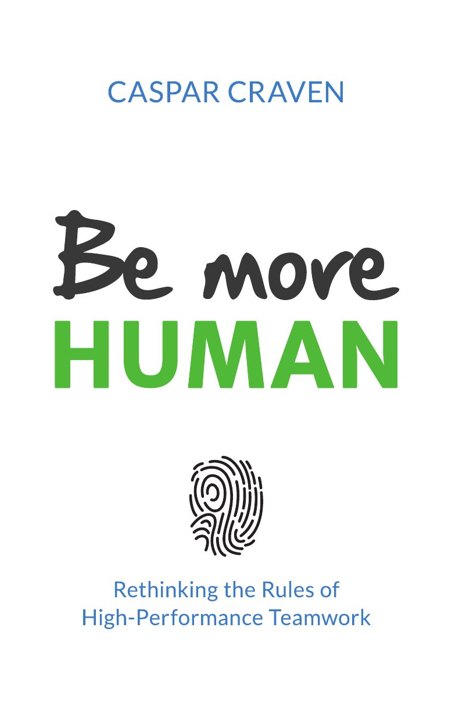
From the book Be More Human
The ideas and stories on this page come from Be More Human: Rethinking the Rules of High-Performance Teamwork by Caspar Craven: what he learnt, often the hard way, about building teams in business, at home and at sea. It's written for anyone asking why their team isn't getting the results it could, or what's wrong with the culture.