

Employee engagement
Employee engagement strategies that put people first
If your team is doing the work but not bringing much of themselves to it, you are not alone. Here are eight practical ways to change that, starting with the one that matters most.
The short answer: engagement is built or lost in the everyday relationship between a leader and their team. Gallup finds the manager accounts for at least 70% of the difference in engagement between teams.3 So the most effective strategy is not a programme. It is how you listen, how you share the direction, and how you handle pressure, week in, week out.
Why most employee engagement strategies stall
Only 20% of employees worldwide say they are engaged at work, the lowest figure since 2020.1 Most large organisations know their own version of that number, and most respond the same way: the annual engagement survey, a corporate action plan, a wellbeing app, a push on targets. The scores rarely move much, because none of it changes what a team member experiences on a Tuesday afternoon with their own manager.
The usual instinct under pressure is to push harder, and in a large organisation that pressure rolls down through every layer. I made this mistake myself. When results slipped in a business I co-ran, I piled the pressure onto the team. My business partner took me aside and told me that if I carried on, everyone would leave, him included. The problem wasn't the team. It was me.
The shift that followed sounds simple and is hard to live by: put people first and the results will follow. In practice that means people who feel fulfilled, in roles that play to their strengths, doing work that matters to them, under a shared mission, with people they trust. The eight employee engagement strategies below are ways to build each of those things.
Eight people-first employee engagement strategies
-
Listen first, then play it back
Everything else rests on trust, and trust starts with listening properly. Sit down with each person in your team, phones and laptops away, and ask what's going on for them and what's important to them.
Don't expect the full truth first time. Whatever you hear, write it down, play it back so they know it landed, and then look for ways to help them get what matters to them. You don't need anyone's permission to start, and others tend to copy it.
Try this week: one distraction-free conversation with each direct report. Ask, write it down, play it back.
-
Turn the strategy into your team's story
In a large organisation the vision and strategy are set at the top. But a corporate strategy deck rarely tells a team member why their work matters on a Monday morning. The leader's job is to translate it: what does the organisation's direction mean for this team, and what part do we play in it?
Do it with the team, not for them. Share the bigger picture honestly, then ask open questions. Where do we want to be in a year? What would make us proud? How does our work help the organisation get where it's going? People commit to a story they helped write.
I learnt this by getting it wrong. I once spent weeks writing a one-page vision on my own, laminated it and put it on every desk. Months later I asked the team what it said. After a long silence someone offered: "I think it was something to do with a number." It meant a lot to me and nothing to them.
More on this: how to create a team vision people care about.
-
Bring your organisation's values to life
In most large organisations the values are already set. They're on the website, the intranet and the meeting room walls. The trouble is that a word like "courage" or "integrity" means something different to everyone who reads it, so on its own it changes very little. Your job as a leader isn't to rewrite the values. It's to make them mean something specific to your team.
Take each value in turn and ask the team: "What do we do when we show this value at its very best?" Push for concrete examples rather than more abstract words. "When we show courage at its best, we take on the tough problems instead of putting them off" is something people can act on. "Courage" alone isn't.
Then make the values part of the weekly conversation, not just the annual review. A simple ritual works well: each week, the team calls out a couple of people who lived one of the values, with the specific example. Start it yourself, then hand it over so the team are spotting it in each other.
Try this week: pick one company value and run the "at its very best" question with your team for 15 minutes. Write down the examples and keep them where everyone can see them.
More on this: turning company values into a team charter.
-
Build the skills at home first
The skills that engage a team at work, deep listening, building trust and agreeing a shared direction, are the same ones that make a family work. Many leaders find it easier to practise them at home first, where the stakes feel personal and the feedback is honest, and then bring them back into the office. How you do anything is how you do everything.
That was my route. For years my marriage ran on a pattern of trivial triggers and escalating arguments, and I carried it into work every morning. Learning to listen and co-create at home was what eventually changed how I led at work.
A good place to start is your blind spots: notice where you keep tripping up, or ask people who know you well to tell you the truth.
Try this week: pick one listening habit from strategy 1 and practise it at home before you take it to the office.
More on this: how to build a team culture people want to belong to.
-
Play to everyone's strengths
Time spent shoring up weaknesses tends to produce mediocre results at best. Even where job descriptions are fixed, you usually have a lot of say over how work is shared out: who leads which project, who handles which client, who mentors whom. Find out what each person is best at and what energises them, and use that freedom. Tools such as CliftonStrengths (formerly StrengthsFinder) give the team a shared language for the conversation.
-
Be the buffer, not the amplifier
In a large organisation, pressure arrives from above: a revised forecast, a restructure, a new set of priorities. The easy thing is to pass it straight down. Good leaders do something harder: they are honest with the team about the reality, and at the same time absorb enough of the pressure that people have room to do their best work. Early in my career I simply passed targets, and the stress that came with them, straight on. It never produced the results I hoped for.
-
Take ownership, especially when it's hard
Teams take their lead from how their leader behaves when things go wrong. In a big organisation it is easy to point at another department, a system or a decision made higher up. Instead, act as though you are fully responsible for your team's situation, even when the cause sits elsewhere. Write down every option you can see, make the best decision you can, and own the outcome. That example gives everyone else permission to do the same.
More on this: accountability in the workplace without blame.
-
Play the long game
A business coach once told me: "The purpose of a goal is not necessarily to hit the goal, but to develop the skills and the team so that we are capable of hitting the goal." Teams that only chase the next number ride a roller coaster of morale. Teams that build trust and skills steadily tend to stay together and keep improving, even when a target slips.
More on this: how engagement drives retention.
Where to start this week
- Hold one listening conversation with each person in your team, with phones and laptops away. Write down what they say and play it back.
- Ask the team one question: "How does what we do help the organisation get where it's going?" If the answers don't match, or don't stir any feeling, you've found your first project.
- Notice where you are passing pressure down instead of absorbing it, and change one of those moments.
None of this is a quick fix. Think of it like gardening: plant the seeds, keep up the sunshine and water, and give it time. Expecting an oak tree by next week only leads to disappointment.
Questions people ask
What is the most effective employee engagement strategy?
Start with how managers behave day to day, and with listening in particular. The manager accounts for most of the difference in engagement between teams, so programmes and perks matter far less than what happens in the weekly conversations.
Why do carrot and stick approaches fail?
They put the numbers ahead of the people who deliver them. People do things for their reasons, not yours. A team that is pushed rather than engaged may hit a number once, but it won't keep going the distance.
How long does it take to improve engagement?
Longer than a quarter. Some changes, like listening properly, show up within weeks. Culture and values take months of steady work.
Can one manager really change engagement in a large organisation?
Yes. You can't change the company's pay structure or strategy on your own, but Gallup's research suggests the manager accounts for at least 70% of the difference in engagement between teams. How you listen, translate the strategy and handle pressure is largely within your control.
Does this work for remote and hybrid teams?
Yes. Listening, a shared story and agreed values matter even more when people aren't in the same room, because there are fewer chance moments to build trust.
Related guides
Sources
The stories and strategies on this page come from the book. The figures in the blue boxes come from the published research below.
- Gallup (2026). State of the Global Workplace: 2026 Report.
- Gallup (2024). The Relationship Between Engagement at Work and Organizational Outcomes: Q12 Meta-Analysis, 11th edition.
- Beck, R. and Harter, J. (2015). Managers Account for 70% of Variance in Employee Engagement. Gallup Business Journal.
- Gallup (2014). Employees Who Use Their Strengths Outperform Those Who Don't.
- Dhingra, N., Samo, A., Schaninger, B. and Schrimper, M. (2021). Help your employees find purpose, or watch them leave. McKinsey & Company.
- Salesforce. Understand the Value of Inclusive Leadership. Trailhead.
- Edmondson, A. (1999). Psychological Safety and Learning Behavior in Work Teams. Administrative Science Quarterly, 44(2), 350 to 383.
- Greenhaus, J. and Powell, G. (2006). When Work and Family Are Allies: A Theory of Work-Family Enrichment. Academy of Management Review, 31(1).
- Dvorak, N. and Nelson, B. (2016). Few Workers Apply Their Company's Values to Their Jobs. Gallup Business Journal.
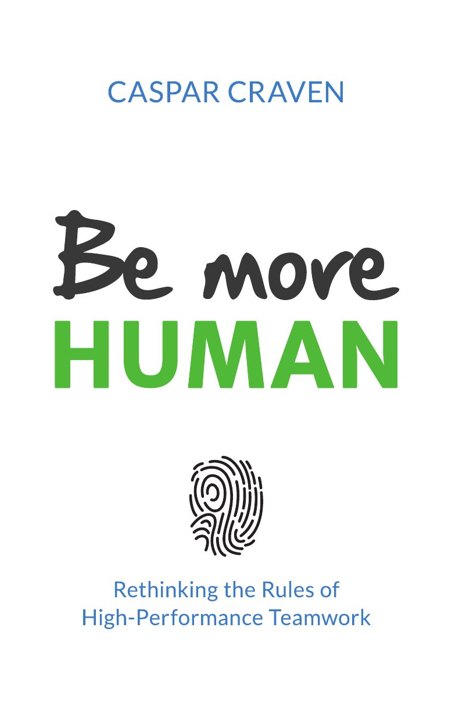
From the book Be More Human
The stories and strategies on this page come from Be More Human: Rethinking the Rules of High-Performance Teamwork, Caspar Craven's account of what he learnt, often the hard way, about building teams in business, at home and at sea. It's written for anyone who finds themselves asking why the team isn't getting the results they want, or what's wrong with the culture.