

Team resilience
How to build team resilience
Sooner or later, something will go badly wrong. A lost client, a restructure, a crisis nobody saw coming. Whether your team holds together depends far less on what happens in that moment than on what you built in the months before it.
The short answer: team resilience is built in calm times, not in the storm. Teams that trust each other, share a clear set of values and know who does what are the ones that hold together under pressure. When something goes wrong, pause before reacting, get a clear view of the real situation, and use what you have rather than wishing for what you don't.
Five hundred miles from land
Some years ago my wife and I were sailing across the Pacific with our three young children, then aged nine, seven and two. More than 500 miles from the nearest land, in rough weather, we lost all power. No engine, no navigation instruments, no autopilot, no lights, no cooker, no working toilets. There were no rescue services within reach. We had to work it out ourselves.
What got us through wasn't a contingency plan, although we had plenty of those. It was the way we had learnt to work together as a team over the previous five years. Four days later, hand-steering and navigating by the sun and stars, we arrived safely at the island of Niue.
The same pattern has played out in every business crisis I've been through, from the 2008 financial crisis, when our sales pipeline effectively switched off overnight, to a key salesperson being suddenly called away by a family tragedy while holding over 80% of that quarter's pipeline. The circumstances differ. The way through is the same.
In the moment: pause, then work together
-
Pause and breathe
When something goes wrong, emotions spike and things usually look worse than they are. I've learnt a simple mantra: things are rarely as bad as they look, or as good as they look, in the first moment. Take a breath and let the first rush of emotion pass before you decide anything. It's the same thing military personnel are taught to do.
-
Watch for your old reflex
Everyone has a default reaction under pressure. Mine was blame. In that storm in the Pacific, the old urge to find fault rose up straight away. Recognising it for what it was, an old habit that wouldn't fix anything, meant I could choose a different response. Blame would have started an argument and used up all our energy on the wrong thing.
-
See the situation as it really is
Assess calmly what is actually at risk. Out on the ocean, we worked out that we were far from shipping lanes, nobody was hurt and the boat was riding the waves as it was designed to. We weren't in immediate danger. That clarity calmed everyone and let us focus.
-
Use what you have
In 2008 I remember wanting to say "if only": if only we had more cash, more clients, a bigger team. That thinking doesn't help. A crisis is about being resourceful with what you have. We spoke to our core clients, created new products that met what they needed at that moment, and looked after the team carefully.
-
Remember that your reaction is yours to choose
Stephen Covey's formula is a useful reminder: Event plus Response equals Outcome. You can't control the event. You can control how you, and your team, respond.
Before the storm: how to build team resilience now
- Trust. Built through listening and acting on what you hear, long before it's needed. See building team culture.
- Values people actually use. In the Pacific our values were our blueprint. We had talked about them over breakfast every day for a year, so when we sat around the table in the dark and asked "what would we do now if we were living our values?", the answers came quickly. The first was laughter. With no working toilets, a bucket became our new "bucket and chuck it" system, and the children thought it was hilarious. Morale held.
- Clear roles. In a crisis, decisions often need to be made quickly by one person. Agree in calm times who decides what, so there's no confusion when it counts.
- The right people. One person actively working against the team can make a hard situation much harder. Deal with it in calm times.
- A habit of debriefing. After anything difficult, talk through what happened and what you'd do differently, without blame.
Crises pass, even when it doesn't feel like they will. The teams that come out stronger are the ones that did the quiet work beforehand.
Try this week: ask the team, "If we lost our biggest client tomorrow, who would decide what, and what would we do first?" The gaps in the answers show you what to build.
Questions people ask
What is team resilience?
A team's ability to hold together and keep functioning when things go wrong, and to recover and learn afterwards. It depends heavily on trust, shared values and clear roles built before the crisis.
How do you build resilience in a team?
Build trust through listening, turn values into habits the team uses every week, agree roles and decision-making in calm times, deal with corrosive behaviour early and debrief difficult moments without blame.
What should a leader do when a crisis hits?
Pause before reacting, watch for your own default response under pressure, assess the real situation calmly, involve the team in finding solutions and focus on what you can control.
Related guides
Sources
The stories and practical ideas on this page come from the book. The figures in the blue boxes come from the published research below.
- Buckingham, M. (2021). The Top 10 Findings on Resilience and Engagement. ADP Research Institute study of more than 26,000 workers in 25 countries.
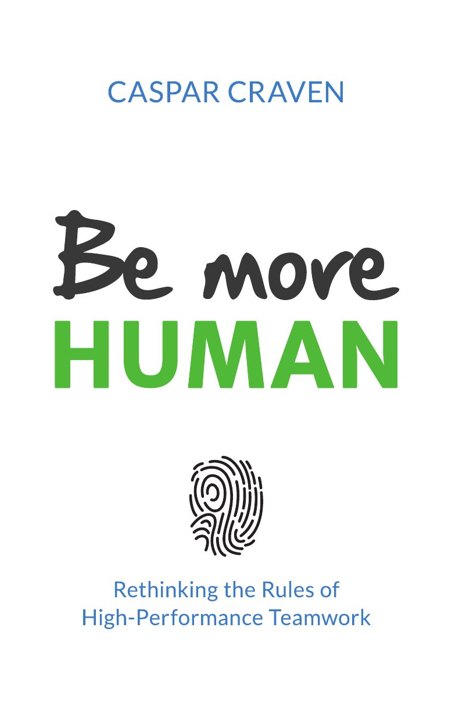
From the book Be More Human
The ideas and stories on this page come from Be More Human: Rethinking the Rules of High-Performance Teamwork by Caspar Craven: what he learnt, often the hard way, about building teams in business, at home and at sea. It's written for anyone asking why their team isn't getting the results it could, or what's wrong with the culture.