

Employee engagement
The drivers of employee engagement
Pay and perks matter, but they aren't what make people care. These are the seven drivers that move engagement up or down, and every one of them can be influenced by the person leading the team.
The short answer: the biggest drivers of employee engagement are trust in the manager, feeling heard, knowing what is expected, understanding how your work contributes, using your strengths, making progress, and being recognised. Most of them live in the relationship between a leader and their team, which is why the manager accounts for at least 70% of the difference in engagement between teams.1
Why pay isn't on the list
Pay matters. If people feel underpaid or treated unfairly it will drag engagement down, and fixing that is part of the job. But once pay is fair, more of it rarely buys more commitment. Ask people what makes them want to give their best and the answers are almost always about the people they work with and the work itself. Feeling listened to, and feeling that their boss genuinely cares about them, consistently come near the top. Money is much further down.
That is good news for a leader inside a large organisation. You may have little say over salary bands. You have a great deal of say over the seven drivers below.
Seven drivers of employee engagement you can influence
-
Trust
Everything else rests on it. Trust can't be demanded. It is earned slowly through small, consistent actions and can be lost quickly through a handful of bad ones. The old line is that trust arrives on foot and leaves on horseback.
You can tell when trust is thin: people pay lip service to requests, keep their ideas to themselves for fear of criticism, or point the finger when something goes wrong.
-
Feeling heard
There is little more powerful, or rarer, than someone giving you their full attention. The test is what happens next: trust grows when people see you act on what you heard.
-
Knowing what's expected
It sounds basic, and it is often missing. In a fast-changing organisation, priorities shift, roles blur and people quietly lose track of what good looks like. Clarity about roles, decisions and standards removes a surprising amount of friction.
-
A story people can connect to
People want to know that their work matters. In a large organisation the strategy is set at the top, but it rarely explains why someone's job matters on a Monday morning. A leader who translates the strategy into a simple story for the team, and builds it with them, gives people something to commit to. More on this in how to create a team vision.
-
Using their strengths
We are all better at some things than others, and we tend to underrate the things we do brilliantly because they come easily. People who spend more of their day doing what they are best at are more energised and more productive.
-
Making progress
Nothing kills motivation faster than effort that goes nowhere. Clearing obstacles, breaking big goals into visible steps and marking small wins does more for morale than any rousing speech.
-
Recognition
Our brains are wired to spot what is wrong, so most feedback at work is about problems. Deliberately noticing what people are doing well, and saying so specifically, shifts the balance. It works best when it's frequent, specific and tied to what the team values.
What sits underneath all seven
Look closely and every one of the drivers of employee engagement comes back to the same thing: whether the people leading a team treat its members as people rather than resources. I spent the early part of my career doing the opposite, focused on the numbers and driving people to hit them, and I got compliance at best. When I started with the people, the numbers improved faster than they ever had.
If you want somewhere to begin, start with trust and listening. They make every other driver easier. The eight people-first strategies show how to put each driver into practice.
Try this week: score your team from 1 to 5 on each of the seven drivers, then ask two or three team members to do the same. The gaps between your scores and theirs are where to start.
Questions people ask
What is the number one driver of employee engagement?
The relationship with the manager, and trust in particular. Gallup puts at least 70% of the variance in team engagement down to the manager, and trust is what that relationship is built on.
Is pay a driver of engagement?
Unfair pay drags engagement down, so it needs to be right. But once pay is fair, more money rarely buys more commitment. The drivers that lift engagement are mostly about how people are led.
Which drivers can a middle manager influence?
Nearly all of them. Trust, listening, clarity, translating the strategy, strengths, progress and recognition all sit largely within a team leader's control, even in a large organisation.
Related guides
Sources
The stories and practical ideas on this page come from the book. The figures in the blue boxes come from the published research below.
- Beck, R. and Harter, J. (2015). Managers Account for 70% of Variance in Employee Engagement. Gallup Business Journal.
- Edmondson, A. (1999). Psychological Safety and Learning Behavior in Work Teams. Administrative Science Quarterly, 44(2), 350 to 383.
- Salesforce. Understand the Value of Inclusive Leadership. Trailhead.
- Harter, J. (2026). U.S. Employee Engagement Declines From 2020 Peak. Gallup.
- Dhingra, N., Samo, A., Schaninger, B. and Schrimper, M. (2021). Help your employees find purpose, or watch them leave. McKinsey & Company.
- Gallup (2014). Employees Who Use Their Strengths Outperform Those Who Don't.
- Amabile, T. and Kramer, S. (2011). The Progress Principle. Harvard Business Review Press. Summary: The Worth of Small Wins: Teresa Amabile and Steven Kramer on The Progress Principle. American Management Association.
- Yi, R. (2024). Employee Retention Depends on Getting Recognition Right. Gallup, with Workhuman.
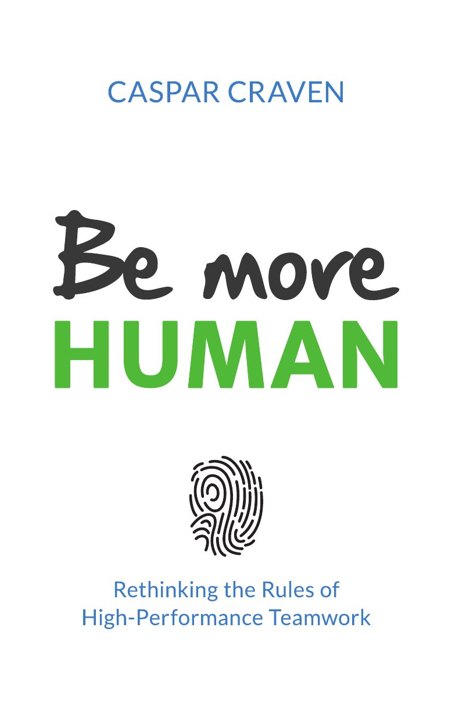
From the book Be More Human
The ideas and stories on this page come from Be More Human: Rethinking the Rules of High-Performance Teamwork by Caspar Craven: what he learnt, often the hard way, about building teams in business, at home and at sea. It's written for anyone asking why their team isn't getting the results it could, or what's wrong with the culture.