

Employee engagement
What is employee engagement?
Engagement is one of the most used and least understood words in business. Here is what it actually means, how to spot it in your own team, and why it matters more than most people think.
The short answer: employee engagement is how much people care about their work and their team, and how much of themselves they choose to bring to it. Engaged people put in discretionary effort because they want to, not because they are told to. It is not the same as being happy or satisfied, and it is shaped far more by a person's manager than by company-wide programmes.1
What is employee engagement? A simple definition
Most people at work do what is asked of them. Engaged people do more than that. They notice the problem nobody else spotted, they help a colleague without being asked, they think about the work on the drive home because they care how it turns out. That extra effort can't be bought or ordered. People choose whether to give it.
Gallup, which has measured engagement for decades, sorts employees into three groups. Engaged employees are thriving at work. Not engaged employees are, in Gallup's phrase, quietly quitting: present, doing the job, but holding back. Actively disengaged employees are loudly quitting, and their unhappiness spreads to others.2
What engagement is not
It helps to be clear about the things engagement often gets confused with, because each leads to the wrong fix.
- It isn't satisfaction. Someone can be perfectly satisfied with their pay and their desk and still give the bare minimum. Satisfaction is about whether people are content. Engagement is about whether they are committed.
- It isn't happiness. A team can be under real pressure and highly engaged at the same time, because they believe in what they are doing and trust the people around them.
- It isn't perks. Free lunches, wellbeing apps and away days are nice to have. On their own they rarely change how someone feels on a Tuesday afternoon with their own manager.
- It isn't the survey score. The annual engagement survey measures it. It doesn't create it. The score only moves when something changes in the day-to-day experience of work.
Why employee engagement matters
Employee engagement isn't a soft issue. Gallup's meta-analysis of more than 183,000 business units and over three million employees found that the most engaged units outperform the least engaged on almost everything that matters to a business.4
There is a human side too. People spend a large part of their waking lives at work. A team that feels trusted, listened to and part of something worthwhile goes home in better shape than one that doesn't, and that shows up in families as well as in results.
Where engagement comes from
The single biggest factor is the relationship between a person and their manager. Gallup found that managers account for at least 70% of the variance in engagement between teams.1 In a large organisation that is both a warning and an opportunity. You can't change the pay structure or the company strategy on your own. But most of what decides whether your team is engaged sits inside your own team, in how you listen, how you share the direction and how you handle pressure.
I learnt this the hard way. Early in my career I was the kind of manager who passed every target and every ounce of pressure straight down to the team. I thought that was leadership. It wasn't. The team did what they had to, and not a lot more.
The idea that changed things for me sounds simple: put people first and the results will follow. In practice that means people feeling fulfilled, in roles that play to their strengths, doing work that matters to them, under a shared mission, with people they trust. Each of those can be built. The drivers of engagement page covers them one by one.
How to tell if your team is engaged
Once you know what employee engagement is, you don't need a survey to get a feel for it. Some signs worth watching for:
- Ideas and bad news both come to you. In an engaged team people speak up early, including when something is going wrong.
- People help each other without being asked. Work flows across the team rather than staying stuck in individual lanes.
- Mistakes are owned, not hidden. In a disengaged team the finger of blame points somewhere else.
- Meetings have energy. People disagree openly, then commit.
- People stay. And when they do leave, it's for a genuine next step, not to get away.
If you recognise the opposite, eye-rolling at new ideas, people keeping their heads down, a quiet sense that requests get lip service and not much more, it's worth taking seriously. Those are signs that trust is wearing thin.
Try this week: ask each person in your team, one to one, "What's one thing that would make your work better?" Write down the answers and play them back. What you hear will tell you more than any dashboard.
Questions people ask
What is the difference between employee engagement and job satisfaction?
Satisfaction is whether someone is content with their job. Engagement is whether they are committed to it and choose to put in extra effort. People can be satisfied without being engaged.
How is employee engagement measured?
Usually through a survey that asks people how strongly they agree with statements about their work, such as whether they know what is expected of them and whether someone at work cares about them. The score is a useful measure, but it changes only when the day-to-day experience of work changes.
Who is responsible for employee engagement?
Everyone plays a part, but the manager matters most. Gallup's research puts at least 70% of the variance in team engagement down to the manager, which is why engagement can't simply be handed to HR.
Related guides
Sources
The stories and practical ideas on this page come from the book. The figures in the blue boxes come from the published research below.
- Beck, R. and Harter, J. (2015). Managers Account for 70% of Variance in Employee Engagement. Gallup Business Journal.
- Gallup (2026). State of the Global Workplace: 2026 Report.
- Harter, J. (2026). U.S. Employee Engagement Declines From 2020 Peak. Gallup.
- Gallup (2024). The Relationship Between Engagement at Work and Organizational Outcomes: Q12 Meta-Analysis, 11th edition.
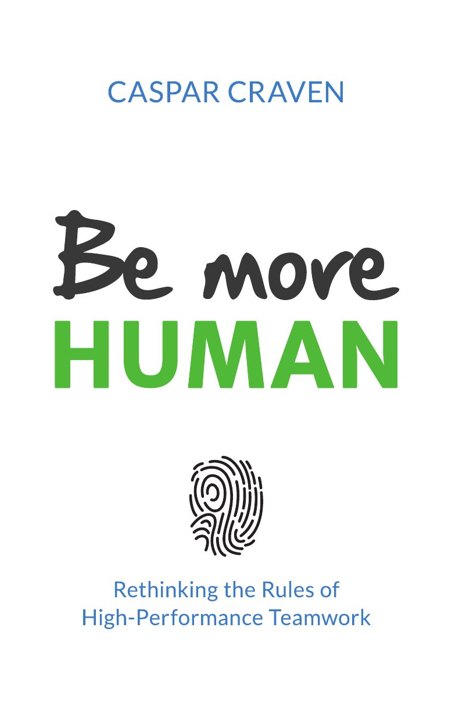
From the book Be More Human
The ideas and stories on this page come from Be More Human: Rethinking the Rules of High-Performance Teamwork by Caspar Craven: what he learnt, often the hard way, about building teams in business, at home and at sea. It's written for anyone asking why their team isn't getting the results it could, or what's wrong with the culture.